

Covering the Synod: 60 Days that Shaped a Turning Point in the Church
Review by Mark Guevarra
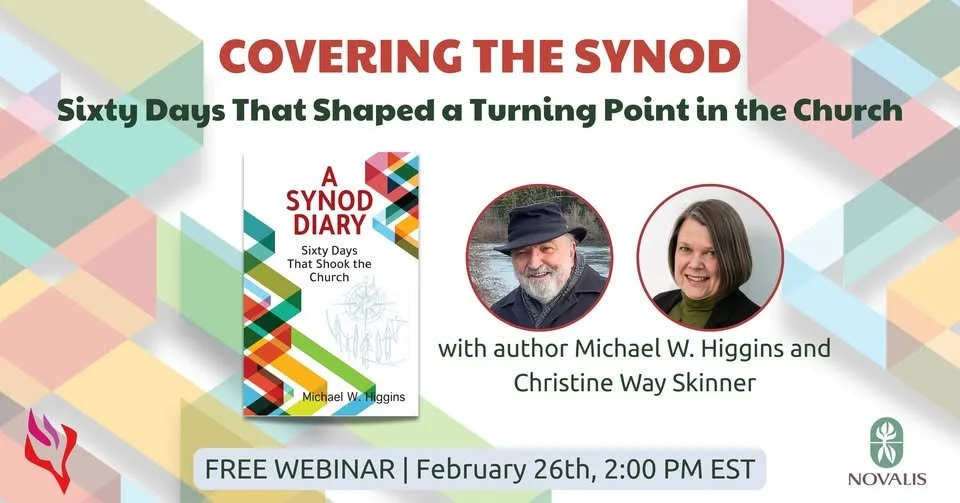
On February 26, in a webinar co-sponsored by Novalis and Concerned Lay Catholics, Michael W. Higgins offers personal background to his latest book, “A Synod Diary: Sixty Days That Shook the Church.” Along with Christine Way Skinner, doctoral candidate and Vice Chair of Concerned Lay Catholics, and moderated by Fr. Édouard Shatov, the webinar offers a candid discussion on the real challenges as well as the transformational significance of the 2021-2024 Synod on Synodality.
Higgins described his book as an attempt to offer “a portal” into how the church understands itself and how it can be itself more authentically. In both synod gatherings, he observed not only the formal proceedings but also the personalities, tensions, and unexpected graces that shaped the gathering. Like the storming of the Bastille — an event that became emblematic of a broader movement — the synod may come to symbolize a turning point in the history of the church. Higgins emphasized that the synod captured something of the “fever and fervour” of the Holy Spirit at work among delegates.
Providing historical context, Higgins explained that earlier synods were primarily episcopal and tightly controlled. Under Pope Francis, however, the structure and spirit of the synod changed significantly. The geography and choreography shifted from hierarchical rows to dynamic round tables, embodying a new emphasis on listening and dialogue. The final forty+ page report, accepted by Francis as official teaching without modification, reflected the dynamism and transformation of the traditional synod gathering. Higgins stressed that the radical dimension of this synod was not primarily its topics — though none were entirely excluded, and ten study groups were established to examine complex issues such as women’s ordination to the diaconate, polygamy, and LGBTQ inclusion — but its method. The process itself modeled a Church that listens rather than merely teaches, one that gathers baptized Christians together in mutual respect to discern truth.
Christine Way Skinner approached the synod from both an academic and pastoral perspective. Beginning doctoral studies on abuse of power in the Church at the same time the synod commenced, she saw synodality as a hopeful response to deep ecclesial wounds. Drawing from her years as a lay pastoral minister, she emphasized the transformative power of listening. In her experience, polarization often stems from people not feeling heard. Synodality, grounded in the belief that all are made in the image of God, offers greater insight into the movement of the Holy Spirit in the lives of all people, and clear vision of how to live out our mission as Christians. Synodality embodies communion, and courageous and creative participation among the laity in the life of the Church.
Both speakers acknowledged significant challenges. Major change is difficult and often counterintuitive. The synod calls for conversion — personal, structural, and relational — and conversion is hard. People resist surrendering power, and some fear synodality as a threat. Higgins argued that while lay leadership is crucial, episcopal leadership is essential for implementation. Without bishops actively teaching and promoting synodality, inertia could stall the process. Many clergy, he suggested, remain unclear about what synodality is, and what it entails. Systematic formation is urgently needed.
The conversation also touched on ideological rigidity. Higgins cautioned against fundamentalist ideology but instead advised, as Pope Francis modelled, an openness to seek the truth in humility. He recounted a personal encounter in Rome with a woman advocating for women’s ordination. Her thoughtful, passionate engagement prompted him to reconsider his own assumptions, illustrating how genuine listening can foster conversion.
In the end, the webinar conveyed cautious but real hope. The synod is not a devolution of power but a recognition of shared responsibility. Though change has and will continue to take place over decades, the process has begun, and is supported by ongoing structures established by Pope Francis, and supported by Pope Leo and the Synod Secretariat. Both Higgins and Skinner encouraged participants not to lose hope. The synodal journey invites all baptized Catholics into a living drama of dialogue and discernment, embodying Pope Paul VI’s conviction that truth is discovered through encounter. The book, and the synod itself, aim to stimulate conversation, deepen communion, and inspire confidence that the Spirit continues to guide the Church forward.