

Safeguarding Worldwide: Current Issues
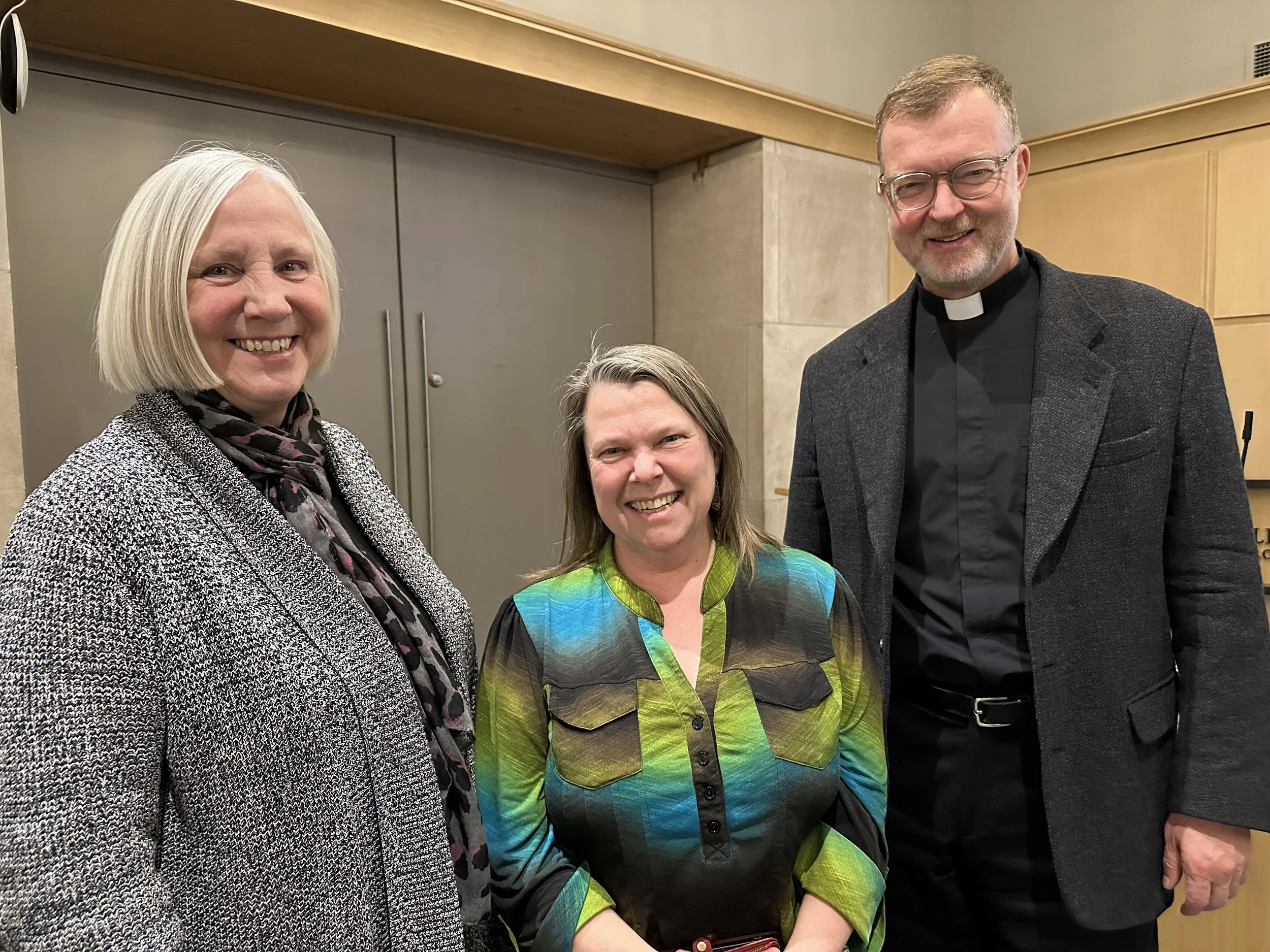
Cathie Pead, Christine Way Skinner, Fr. Hans Zollner
A lecture by Fr. Hans Zollner, SJ, Director, IADC Institute of Anthropology. Pontifical Gregorian University. By Cathie Pead
Cathie Pead and Christine Way Skinner had the opportunity to attend the lecture by Fr Hans Zollner, SJ, at the University of St. Michael's College on Friday March 6. Speaking from his many years of experience working on abuse prevention and response within the global Church, Zollner presented a paradox that sits at the heart of the current moment: the Catholic Church is, in many ways, the largest and most extensive safeguarding organization in the world, yet this reality is often overshadowed by the Church’s continuing difficulty in dealing honestly and effectively with its past.
Zollner argued that significant progress has been made in developing safeguarding policies, training programs, and reporting structures across many parts of the Church. In terms of institutional reach, resources, and the number of people engaged in safeguarding work, the Church has built one of the most comprehensive global frameworks for protecting minors and vulnerable persons. However, this achievement has made little difference to public perception; the Church’s credibility remains weakened by unresolved cases, failures of accountability, and a lack of transparency when it comes to confronting the historical record and failure to support survivors who have been wounded by the Church’s ministers.
Part of the challenge, he suggested, lies in a persistent combination of discomfort, limited knowledge, and an unwillingness in some communities to engage the issue fully. These attitudes contribute to what Zollner described as “safeguarding fatigue.” After years of policies, training sessions, and compliance requirements, some institutions approach safeguarding as a procedural obligation rather than a moral and pastoral responsibility. A check-box mentality can emerge—one that satisfies formal requirements but misses the deeper cultural transformation needed to truly address abuse and its causes.
Within what he described as the “mentality” of the Body of Christ, Zollner identified four interrelated areas or domains that work together to create a corporate mentality or organizational culture: people, processes, structures, and content. It is the interaction of these four domains that produce the corporate mentality.
To change the mentality and create a credible and effective response, we must move from:
“It will go away” → “No it won’t” = Facing reality
“I cannot do anything” → “Yes, you can” = Empowerment
Safeguarding as an isolated specialization → Safeguarding as integral part of mission: pastoral, educational, spiritual, social= Community commitment
Zollner also emphasized that safeguarding cannot be implemented through a single universal model. Cultural, legal, and historical contexts vary widely across countries and dioceses, meaning that responses must be adapted to local realities while maintaining consistent principles. Effective safeguarding therefore requires attentiveness to these differences rather than assuming that one approach can simply be applied everywhere.
Ultimately, Zollner’s presentation was a call for a deeper conversion within the Church: a shift from compliance to commitment, from defensiveness to honesty, and from fatigue to renewed engagement in the shared responsibility of protecting the vulnerable and tending to those already wounded.